When a new badminton brand begins sourcing OEM shuttlecocks, packaging often starts as a secondary consideration.
The buyer usually focuses first on feather grade, cork structure, speed, durability, and unit price. A standard shuttlecock tube appears sufficient, especially for an initial trial order.
That view often changes after the buyer compares an ordinary tube with the packaging used by established badminton brands.
An embossed cap, a clearly marked speed label, an anti-counterfeit sticker, or printing inside the tube may seem like small details. Together, however, they make the product look more complete, more trustworthy, and easier to recognize.
This is why more private label shuttlecock brands are asking factories to reproduce the presentation and practical features seen on premium branded tubes.
The benefit is real. So is the additional cost.
The right question is therefore not whether custom shuttlecock packaging is more expensive. It is whether the extra packaging cost creates enough value for the brand and its customers.
Why Shuttlecock Packaging Matters More Than It Appears
A shuttlecock tube does several jobs at the same time.
It protects the shuttlecocks during transportation and storage, identifies the product grade and speed, carries the brand image, and gives the customer a first impression before the tube is opened.
For distributors and club players, packaging also makes the product easier to organize. A clearly marked speed sticker allows warehouse staff, retailers, and players to distinguish speed 75, 76, 77, 78, or 79 without opening the tube.
For a private label badminton brand, the tube may be the most visible part of the product. Players may discard the shipping carton immediately, but the shuttlecock tube stays beside the court and may be seen repeatedly by other players.
That repeated exposure gives branded packaging value beyond decoration.
A well-designed tube can help a new product appear established, even when the brand itself is still entering the market.
What Premium Custom Shuttlecock Packaging Can Include
Custom shuttlecock packaging is not one single option. It is a combination of materials, printing processes, accessories, and finishing details.
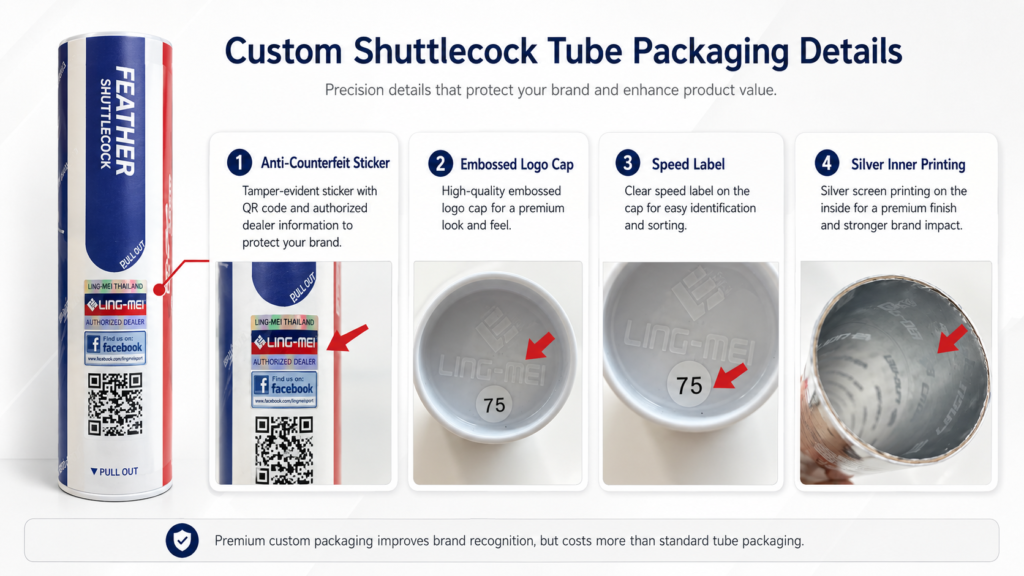
The packaging example shown above includes four common premium features.
1. Anti-Counterfeit Sticker
An anti-counterfeit sticker can be placed across the tube seal or on the main body of the packaging.
Depending on the buyer’s requirements, it may include:
- a QR code
- a unique verification number
- tamper-evident material
- holographic effects
- an authorized dealer label
- batch or product information
For a small brand, counterfeiting may not be an immediate problem. However, verification labels can still improve trust because they show that the product has a controlled distribution and identification system.
A QR code can also direct users to:
- the official website
- product specifications
- playing and storage instructions
- distributor information
- authentication pages
- customer service channels
The value depends on what happens after the customer scans it. A QR code leading to an unfinished home page adds little value. A code connected to useful product and verification information can become part of the buying experience.
2. Embossed Logo Cap
A standard tube cap is usually plain. An embossed logo cap requires a dedicated mould or customized cap production.
The logo is pressed or formed directly into the plastic surface, creating a three-dimensional brand mark.
Compared with an ordinary printed sticker, an embossed cap:
- looks more permanent
- is difficult to peel off or damage
- improves brand recognition
- makes the tube appear more professionally developed
The disadvantage is cost.
The buyer may need to pay for tooling, mould development, or a higher minimum production quantity. Different cap sizes or structures may also require separate development.
For this reason, an embossed logo cap is usually more suitable for a brand with a confirmed product design and recurring orders. It may not be economical for a small sample project or a brand that is still changing its name and visual identity.
3. Shuttlecock Speed Sticker
The speed sticker is one of the simplest packaging details, but it has an important practical function.
Feather shuttlecocks are supplied in different speeds because temperature, altitude, humidity, and indoor playing conditions affect flight distance.
A visible speed sticker helps buyers and players identify the correct product quickly.
For example, the same packaging design can be used for several speeds, while different stickers indicate:
- speed 75
- speed 76
- speed 77
- speed 78
- speed 79
This is generally more economical than printing a completely different tube for every speed.
However, the sticker must be applied consistently. Poor positioning, weak adhesive, unclear printing, or incorrect speed labeling can create confusion and make the product look unprofessional.
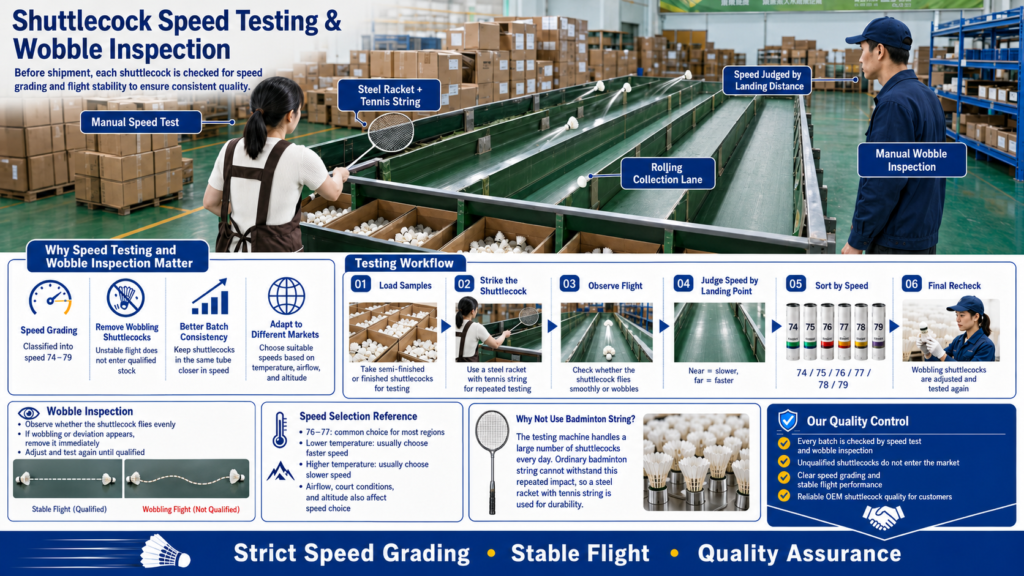
The packaging process therefore needs to match the factory’s speed testing and sorting system. A speed 77 sticker has value only when the shuttlecocks inside have actually been tested and classified correctly.
4. Silver Screen Printing Inside the Tube
Printing on the inner surface of a shuttlecock tube is a less common but distinctive branding feature.
Silver or metallic screen printing can create a subtle visual effect when the customer opens the tube. It may include:
- the brand logo
- a slogan
- product information
- a repeated graphic pattern
- authenticity marks
This type of detail is rarely necessary for basic protection, but it contributes to the premium presentation of the product.
It also demonstrates that the packaging was developed specifically for the brand rather than assembled from a generic tube and label.
The additional cost normally comes from:
- screen setup
- metallic ink
- production handling
- extra printing steps
- minimum print quantity
- quality inspection
For a premium tournament shuttlecock, the visual effect may support the selling price. For a basic training shuttlecock, the same expense may be difficult to recover.
Why New Brands Follow Established Packaging Designs
Many new shuttlecock brands study the packaging used by successful companies before creating their own tubes.
This is understandable.
Established brands have already taught players what professional badminton packaging normally looks like. Buyers have become familiar with certain features:
- visible product grade
- clear shuttlecock speed
- sealed tube
- official branding
- consistent colors
- recognizable cap design
- authenticity information
A new brand that ignores all these conventions may look unfinished beside competing products.
However, there is an important difference between learning from established packaging and copying it too closely.
A private label brand should follow useful packaging principles without imitating another company’s protected trademarks, artwork, distinctive color combinations, or brand presentation.
The objective is to achieve the same level of professionalism, not to make customers believe the product belongs to another brand.
Why Custom Shuttlecock Packaging Costs More
Buyers sometimes compare a customized tube with a standard tube and assume the difference should only be the cost of printing.
In practice, several expenses are involved.
Artwork Preparation
The factory needs usable production files with correct dimensions, colors, bleed areas, and printing specifications.
If the artwork requires repeated correction, sample production becomes slower and more expensive.
Printing Setup
Offset printing, screen printing, metallic finishes, and special inks each require separate setup. The setup cost is spread across the order quantity, which is why small orders have a higher packaging cost per tube.
Embossed Cap Tooling
A customized embossed cap normally requires mould or tooling development. This is a one-time cost if the design remains unchanged, but it increases the cost of the first order.
Anti-Counterfeit Materials
Security labels, holographic stickers, unique codes, and tamper-evident materials cost more than ordinary paper stickers. Variable codes may also require digital printing and data management.
Multiple Speed Labels
Selling several shuttlecock speeds requires separate labels and stricter packaging control to prevent mixing.
Inner Tube Printing
Printing inside the tube adds another production operation and may require special equipment or handling.
Higher Material and Inspection Requirements
Premium packaging exposes defects more easily. Color differences, scratched metallic printing, uneven embossing, or misplaced labels may cause rejection, increasing production waste.
This is why a customized shuttlecock tube cannot always match the price of standard packaging.
When Premium Packaging Is Worth the Investment
Custom packaging makes the most sense when it supports a clear sales strategy.
It is usually worthwhile when:
- the shuttlecock is sold under a long-term private label
- the buyer has repeat orders
- the product is positioned above entry level
- the tube will be displayed in retail stores
- the brand sells through distributors
- customers compare the product directly with recognized brands
- product authentication is important
- the packaging supports a higher retail price
For these buyers, packaging is part of the product rather than an unnecessary accessory.
A distributor may accept a higher purchase cost when the tube helps the product look credible and easier to sell.
When Standard Packaging Is the Better Choice
Premium packaging is not automatically the correct choice for every order.
Standard or semi-custom packaging may be more sensible when:
- the buyer is testing the market
- the first order quantity is small
- the brand design is not finalized
- the product is a low-cost training shuttlecock
- customers mainly buy on price
- the shuttlecocks are supplied directly to clubs in bulk
- the packaging cost would make the final price uncompetitive
There is no value in adding an expensive embossed cap to a product whose buyers care almost entirely about cost per game.
The packaging level should match the shuttlecock grade and market position.
A Practical Three-Stage Packaging Plan for New Brands
New badminton brands do not need to add every feature in the first order.
A staged approach usually controls risk better.
Stage 1: Standard Tube with Custom Label
The buyer can begin with:
- standard tube structure
- custom body label
- logo artwork
- speed sticker
- standard cap
This keeps the investment manageable while giving the product a clear identity.
Stage 2: Fully Printed Custom Tube
After the product receives positive market feedback, the buyer can upgrade to:
- fully customized tube artwork
- stronger brand colors
- improved surface finish
- multiple speed labels
- more refined carton packaging
At this stage, the brand should already understand which model and design it intends to keep.
Stage 3: Premium Brand Protection and Finishing
Once repeat demand is established, the buyer can add:
- embossed logo caps
- QR authentication
- anti-counterfeit seals
- metallic or silver printing
- inner tube printing
- unique serial or batch codes
This approach avoids spending heavily on packaging before the shuttlecock itself has been accepted by the market.
Product Quality Must Come Before Packaging
Premium packaging can improve presentation, but it cannot compensate for unstable shuttlecock quality.
A good-looking tube will not create repeat orders if the shuttlecocks inside:
- wobble during flight
- break too quickly
- contain mixed speeds
- use inconsistent feathers
- vary significantly between batches
The correct development sequence is:
- confirm the target market
- choose the shuttlecock grade
- test flight and durability
- confirm speed requirements
- approve the product
- finalize the packaging
Some new buyers start with packaging because it is easier to visualize than product performance. This can lead to a beautiful tube containing a model that has not been tested sufficiently.
A serious OEM shuttlecock manufacturer should help the buyer complete product testing before committing to expensive packaging tooling.
What Buyers Should Send to the Packaging Supplier
To receive an accurate custom packaging quotation, the buyer should provide:
- brand logo in vector format
- preferred tube dimensions
- number of shuttlecocks per tube
- product name and grade
- required shuttlecock speeds
- tube artwork
- cap logo requirements
- security label requirements
- QR code destination
- inner printing requirements
- order quantity
- target market
Without these details, the factory can only provide a rough estimate.
Packaging price can change significantly depending on whether the buyer needs only a printed paper wrap or a complete system with a custom cap, security seal, speed labels, and inner metallic printing.
Final Thoughts
Custom shuttlecock packaging offers real advantages.
It can improve product recognition, make speed identification easier, protect the brand, support retail presentation, and help a private label product compete with established badminton brands.
But every premium feature adds cost.
An embossed cap requires tooling. Anti-counterfeit stickers require specialized materials and possibly unique data. Inner silver printing adds another production step. Small quantities make these expenses more noticeable.
The most effective packaging is not necessarily the most elaborate one. It is the packaging that matches the product grade, target customer, order volume, and brand development stage.
For a new brand, a clean custom label and accurate speed sticker may be enough to begin. For an established distributor launching a premium shuttlecock, embossed caps, security labels, and inner printing may be a worthwhile investment.
The goal should not be to copy every detail used by a famous brand.
The goal is to build packaging that customers recognize, trust, and remember — without allowing the packaging cost to destroy the product’s competitiveness.