For many badminton players, a shuttlecock is simply a small, lightweight object that flies across the court. But for an OEM shuttlecock manufacturer, every shuttlecock begins long before assembly — it starts with the feather.
The quality of a feather shuttlecock depends heavily on the raw feathers used in production. Flight stability, durability, speed consistency, and overall playing feel are all influenced by how feathers are sourced, collected, sorted, and graded.
In this article, we explain the first and most important stage of the shuttlecock manufacturing process: feather sourcing and feather selection.
## Why Feathers Matter in Shuttlecock Production
A standard feather shuttlecock uses 16 carefully selected feathers. These feathers must have similar shape, thickness, curvature, and strength. If even a few feathers are inconsistent, the shuttlecock may wobble, rotate unevenly, or lose speed control during play.
This is why professional feather shuttlecock production requires strict raw material control. For an OEM shuttlecock factory, feather selection is not a simple purchasing step — it is the foundation of product quality.
The most commonly used feathers come from ducks and geese. Goose feather shuttlecocks are often preferred for higher-level play because goose feathers usually have stronger shafts, better elasticity, and more stable flight performance. Duck feather shuttlecocks are widely used for training, club play, and cost-sensitive markets because they offer a good balance between price and durability.
## Where Shuttlecock Feathers Come From
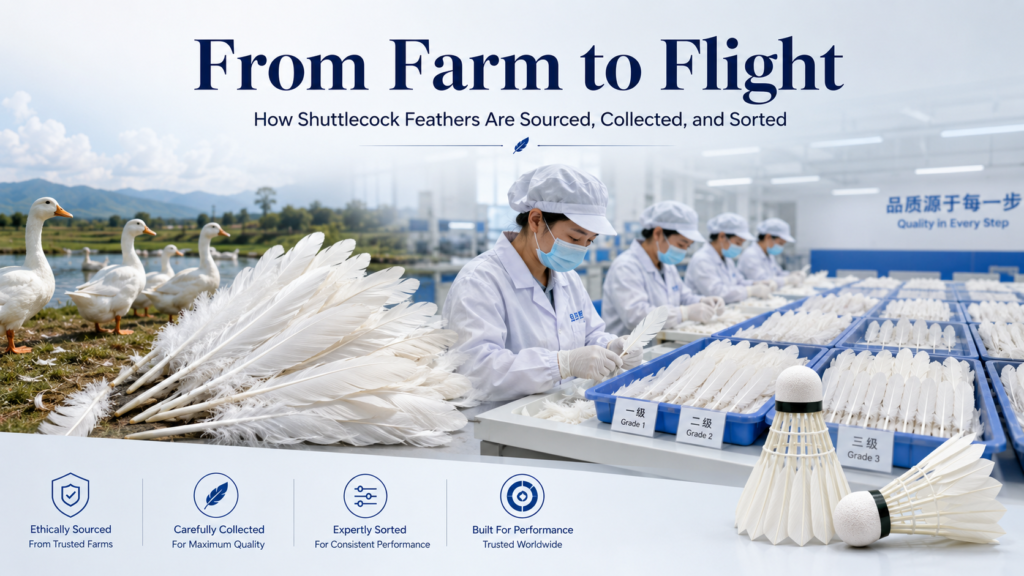
The feathers used for badminton shuttlecocks usually come from the poultry industry, mainly from ducks and geese raised for meat production. In other words, shuttlecock feathers are generally a by-product of food production rather than the primary purpose of farming.
This matters for two reasons.
First, the supply of shuttlecock feathers is closely linked to duck and goose farming. When poultry farming decreases, the supply of usable feathers also drops. This is one reason why feather shuttlecock prices can fluctuate sharply.
Second, not every duck or goose feather can be used to make shuttlecocks. Only selected wing feathers with the right structure can meet the requirements for badminton shuttlecock production.
For high-quality shuttlecocks, factories look for feathers with:
* strong feather shafts
* consistent curvature
* clean appearance
* good elasticity
* suitable length and thickness
* minimal damage
This is why feather shuttlecock raw materials are much more specialized than ordinary feathers used in bedding or apparel.
## Goose Feather vs Duck Feather at the Source
Goose and duck feathers both play important roles in the shuttlecock industry, but they serve different market levels.
### Goose Feather
Goose feathers are generally larger, stronger, and more elastic. They are suitable for club-level, tournament-grade, and premium shuttlecocks. A high-quality goose feather shuttlecock usually provides better flight stability and a more consistent hitting feel.
However, goose feathers are more expensive and less available. Goose farming cycles are longer, and the number of usable wing feathers is limited.
### Duck Feather
Duck feathers are more widely available and more cost-effective. They are commonly used for training shuttlecocks, recreational shuttlecocks, and mid-range club models.
Within duck feathers, there are also different quality levels. Some duck feathers are thicker and more durable, while others are thinner and better suited for lower-cost products. A reliable OEM shuttlecock manufacturer will select the right duck feather grade based on the buyer’s target market.
## How Feathers Are Collected
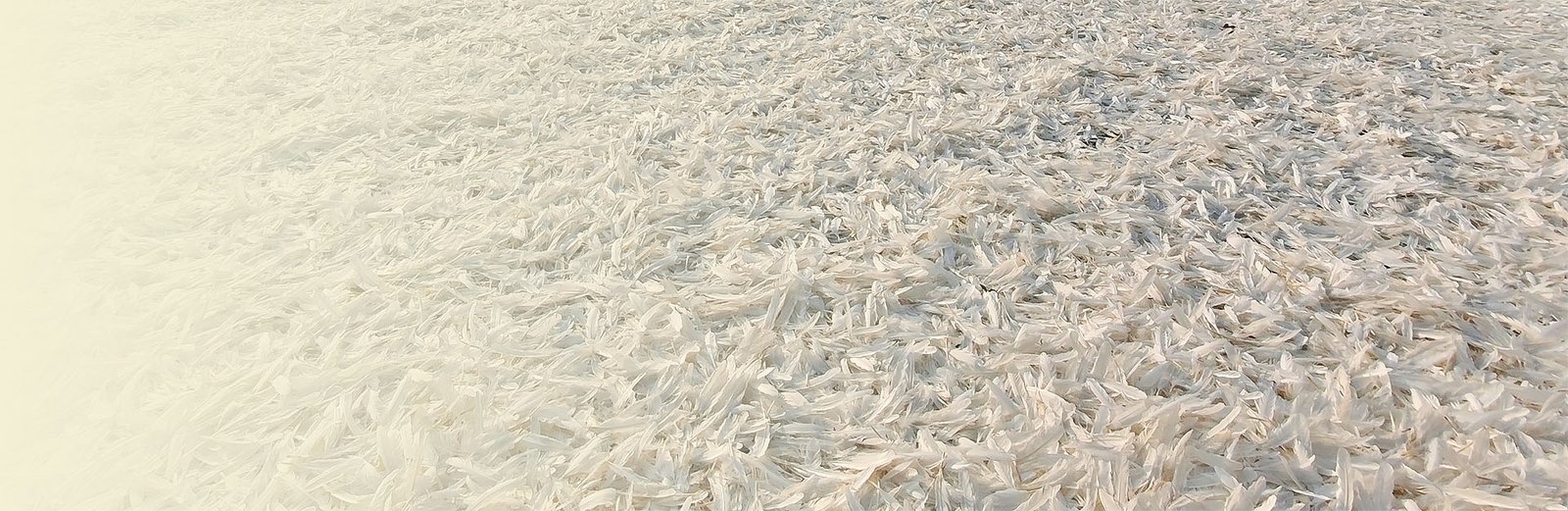
After poultry processing, feathers are collected and transported to feather processing centers. At this stage, the feathers are still mixed and cannot be used directly for shuttlecock production.
Raw feathers usually include:
* wing feathers
* body feathers
* broken feathers
* down feathers
* mixed left-wing and right-wing feathers
* feathers of different lengths and grades
The first job of the feather supplier or feather processing factory is to separate usable shuttlecock feathers from the rest.
For shuttlecock production, wing feathers are the most valuable. These feathers are stronger and more structured than body feathers. They are suitable for cutting and shaping into shuttlecock feather pieces.
This early separation process is important because it determines how much usable material can eventually enter the shuttlecock manufacturing process.
## The First Sorting: Separating Usable Wing Feathers
Once the raw feathers arrive at the processing facility, workers begin the first sorting stage.
They separate feathers by:
* feather type
* size
* wing position
* left wing or right wing
* visible damage
* basic quality level
Damaged feathers, broken shafts, twisted feathers, and feathers with poor structure are removed early. These are not suitable for making stable feather shuttlecocks.
The remaining feathers are grouped for further processing and grading.
In professional shuttlecock production, left-wing and right-wing feathers are usually separated. This is because all 16 feathers in one shuttlecock should come from the same wing direction to maintain stable rotation and flight balance.
## Cleaning and Sterilization
Before feathers can be used in shuttlecock production, they must be cleaned and sterilized.
This process may include:
* washing
* degreasing
* sterilization
* drying
* whitening or color adjustment when required
Clean feathers are easier to grade and safer for manufacturing. Proper washing also improves the appearance of the finished shuttlecock.
However, this process must be carefully controlled. Over-processing may weaken the feather shaft, while insufficient cleaning can affect quality and appearance.
For export-oriented shuttlecock factories, stable cleaning and sterilization standards are important because international buyers often care about product hygiene, consistency, and compliance.
## Fine Sorting and Feather Grading
After cleaning and drying, the feathers enter a more detailed grading process.
Workers evaluate feathers based on:
* length
* thickness
* curvature
* shaft strength
* feather surface condition
* whiteness
* elasticity
This is one of the most labor-intensive steps in the shuttlecock raw material process. Experienced workers can quickly identify which feathers are suitable for different shuttlecock grades.
For example:
* premium goose feathers may be used for tournament-grade shuttlecocks
* strong duck feathers may be used for club training shuttlecocks
* lower-grade feathers may be used for recreational products
A professional feather shuttlecock factory does not use the same feather grade for every product. Instead, feathers are matched to the target price level, playing level, and market requirement.
## Why Feather Matching Is So Important
A shuttlecock must rotate smoothly in the air. This requires all 16 feathers to work together as one balanced structure.
If the feathers vary too much in stiffness, curve, or size, the shuttlecock may fly inconsistently. This is why feather matching is critical before assembly.
Good feather matching helps improve:
* flight stability
* speed consistency
* durability
* balance
* overall player experience
For OEM shuttlecock buyers, this is one of the key differences between low-cost suppliers and professional manufacturers.
A low-cost factory may focus only on appearance and price. A professional OEM shuttlecock manufacturer pays attention to whether the feathers can perform consistently during play.
## How Feather Quality Affects OEM Shuttlecock Orders
For brands, clubs, and distributors, feather quality directly affects customer satisfaction.
If the feather grade is too low, players may complain about:
* fast breakage
* unstable flight
* poor hitting feel
* inconsistent speed between tubes
If the feather grade is too high for a budget product, the cost may become difficult to control.
This is why OEM shuttlecock production requires careful product positioning. The right manufacturer should help buyers choose a feather grade that matches their market.
For example:
* schools may need durable duck feather training shuttlecocks
* clubs may need balanced goose or duck feather shuttlecocks
* tournament organizers may require premium goose feather models
* private label brands may need multiple grades under one product line
The right feather selection strategy helps buyers balance performance and cost.
## Final Thoughts
The journey of a feather shuttlecock begins long before it reaches the court. From duck and goose farms to feather collection, cleaning, sorting, grading, and matching, each step affects the final product.
For any buyer looking for an OEM shuttlecock manufacturer, understanding feather sourcing is essential. A reliable factory should not only assemble shuttlecocks but also understand raw material quality at the source.
In today’s market, where feather prices and supply conditions can change quickly, working with a manufacturer that has strong feather sourcing and grading capability is more important than ever.
If you are looking for a feather shuttlecock factory that supports OEM production, private label packaging, goose feather shuttlecocks, duck feather shuttlecocks, and custom shuttlecock development, choosing the right raw material partner is the first step toward building a stable product line.