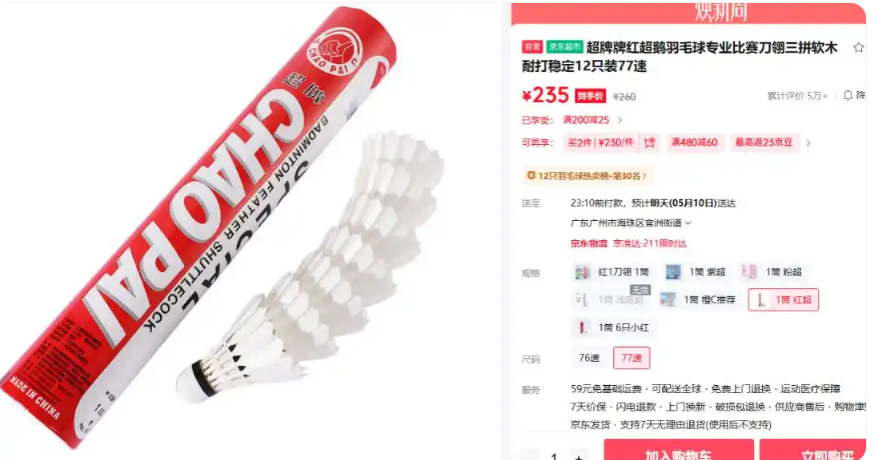
When buyers compare feather shuttlecocks, most attention usually goes to the feathers. Feather quality does matter — it affects flight stability, durability, and speed consistency. But there is another part of the shuttlecock that has a direct impact on playing feel: the cork base.
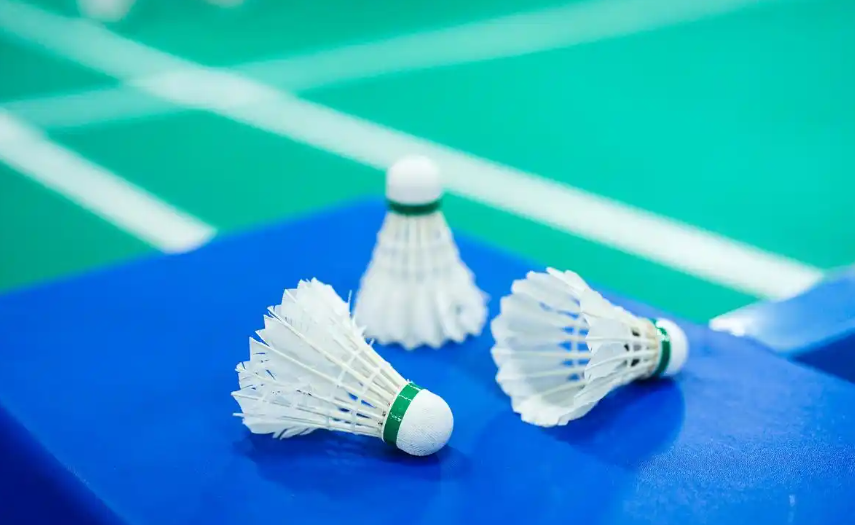
The shuttlecock head, also called the shuttlecock cork base, is the part that contacts the racket string bed during every shot. Its material, density, structure, and outer wrapping all influence the hitting sound, shock absorption, control, and overall playing experience.
For an OEM shuttlecock manufacturer, the cork base is not just a small component. It is one of the key details that separates low-cost training shuttlecocks from high-performance tournament-grade shuttlecocks.
What Is a Shuttlecock Cork Base?
The shuttlecock cork base is the rounded head at the bottom of a feather shuttlecock. It is usually made from cork, composite cork, synthetic foam, or a combination of these materials. The outside is commonly wrapped with white leather or leather-like material to create a smooth, consistent hitting surface.
A well-made shuttlecock head needs to provide three things:
- a clean hitting feel
- stable impact resistance
- consistent weight and balance
If the cork base is too hard, the shuttlecock may feel harsh on impact. If it is too soft, the shuttlecock may lose power and control. If the density is inconsistent, players may feel clear differences between tubes or even between shuttlecocks from the same tube.
This is why professional shuttlecock manufacturing requires strict cork base selection and quality control.
Why the Cork Base Matters in Shuttlecock Performance
During play, the shuttlecock head takes repeated high-speed impacts from the racket. Each impact transfers force through the cork base, then into the feather structure.
A good shuttlecock cork base helps improve:
- hitting feel
- flight control
- shock absorption
- durability
- speed consistency
- player confidence
For clubs, distributors, and private label badminton brands, the cork base directly affects customer feedback. Even if the feathers look good, a poor-quality cork base can make the shuttlecock feel cheap, unstable, or uncomfortable to hit.
That is why experienced OEM shuttlecock buyers always test both feather performance and cork base feel before confirming bulk production.
Main Types of Shuttlecock Cork Bases
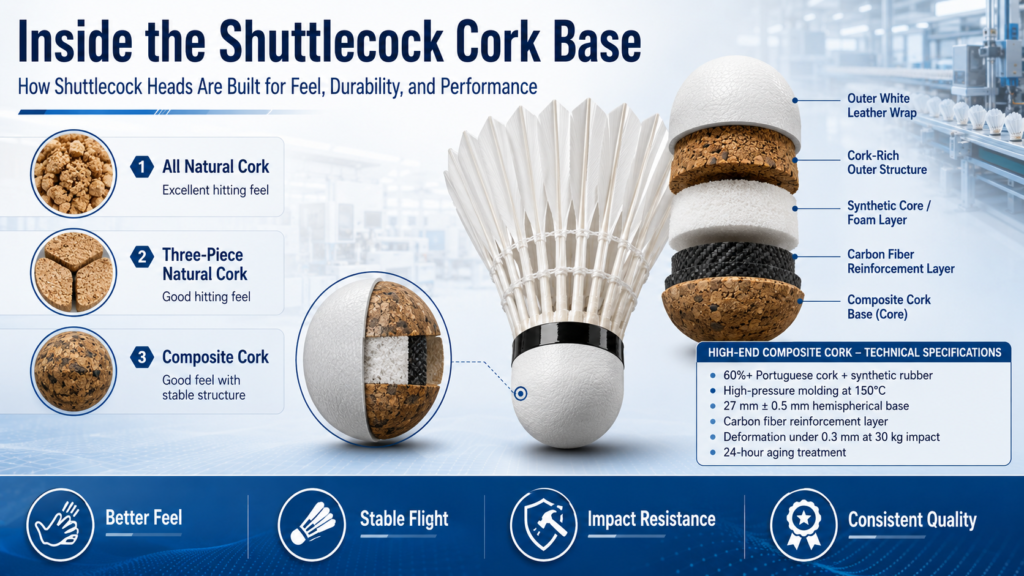
Different shuttlecock grades use different cork base structures. The most common types include all natural cork, three-piece natural cork, and composite cork.
Each type has its own advantages, cost level, and suitable market.
1. All Natural Cork Base
An all natural cork base is made mainly from natural cork material. It provides the best hitting feel among common shuttlecock head materials.
Natural cork offers excellent elasticity and shock absorption. When the racket hits the shuttlecock, the response feels clean, solid, and comfortable. This is why many premium goose feather shuttlecocks and tournament-grade shuttlecocks use natural cork bases.
Advantages of All Natural Cork
All natural cork is preferred for high-level play because it provides:
- excellent hitting feel
- better rebound response
- strong player feedback
- premium product positioning
For competitive players, the difference can be obvious. A shuttlecock with a high-quality natural cork base usually feels more stable and controlled during drives, clears, smashes, and net shots.
Suitable Applications
All natural cork bases are suitable for:
- kok turnamen
- premium club shuttlecocks
- professional training shuttlecocks
- high-end private label badminton brands
However, natural cork is more expensive. For cost-sensitive markets, many buyers choose three-piece cork or composite cork instead.
2. Three-Piece Natural Cork Base
A three-piece natural cork base is a common structure used in mid-to-high-end feather shuttlecocks. It usually combines multiple cork sections to balance performance and cost.
Compared with all natural cork, a three-piece natural cork base still provides a good hitting feel, but at a more controlled price level.
Advantages of Three-Piece Natural Cork
This structure offers:
- good hitting feel
- stable impact performance
- better cost control
- suitable durability for club play
For many badminton clubs and distributors, three-piece natural cork is a practical choice. It gives players a comfortable feel without pushing the shuttlecock into the highest price range.
Suitable Applications
Three-piece natural cork bases are suitable for:
- club-grade goose feather shuttlecocks
- high-quality duck feather shuttlecocks
- training and match-use shuttlecocks
- OEM shuttlecock orders for European and Asian markets
For buyers who want a strong balance between performance and price, three-piece natural cork is often one of the best options.
3. Composite Cork Base
A composite cork base is made from cork particles, synthetic materials, foam, or rubber-based compounds. It is widely used in training shuttlecocks, entry-level feather shuttlecocks, and some cost-controlled OEM shuttlecock models.
Composite cork can provide stable structure and consistent shape. Its main advantage is cost control and manufacturing consistency.
Advantages of Composite Cork
Composite cork bases can offer:
- lower cost
- stable structure
- consistent shape
- good durability for training use
- flexible production control
For beginner training, school badminton, recreational play, and price-sensitive wholesale markets, composite cork can be a practical choice.
However, the hitting feel may not match all natural cork. Players may notice a slightly harder or less responsive impact, especially in higher-level play.
High-End Composite Cork: A More Advanced Structure
Not all composite cork bases are low-end. Some high-end composite cork structures are designed to improve both durability and hitting feel.
In this type of structure, Portuguese cork may be combined with synthetic rubber or PU material to create a more stable cork-rich base. In some designs, the cork content can exceed 60% to help maintain a better hitting feel.
The material can be formed through high-pressure molding, where cork particles and synthetic material are bonded under controlled temperature and pressure. A well-controlled process helps create a uniform hemispherical base with stable density and shape.
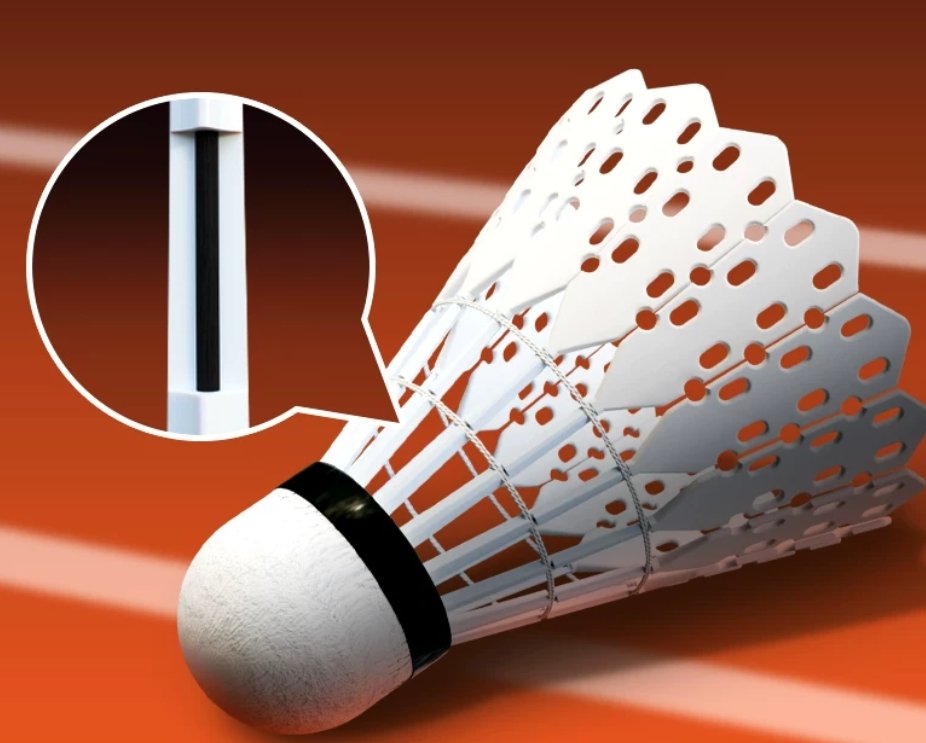
Some advanced composite cork bases may also include reinforcement layers, such as carbon fiber or other structural materials, to improve impact resistance and reduce deformation during repeated hitting.
After molding, the base may go through aging treatment to release internal stress and improve dimensional stability before final assembly.
For OEM shuttlecock production, this type of structure can be useful when buyers want stronger durability while keeping a better hitting feel than ordinary low-cost composite cork.
Outer White Leather Wrap
The outside of the shuttlecock head is usually wrapped with white leather or leather-like material. This outer layer creates a smooth hitting surface and protects the internal cork or foam structure.
The quality of this outer wrap affects:
- surface smoothness
- impact feel
- appearance
- durability
- consistency during play
If the wrapping is uneven, too soft, or poorly bonded, the shuttlecock may feel inconsistent. It may also wear faster during repeated use.
For professional shuttlecock manufacturing, the outer wrap must be tightly fitted, evenly shaped, and clean in appearance.
How Cork Base Quality Affects OEM Shuttlecock Orders
For OEM buyers, choosing the right cork base is a product positioning decision.
A premium badminton brand may need natural cork for a better playing experience. A club supplier may prefer three-piece natural cork to balance cost and performance. A training shuttlecock brand may choose composite cork to keep pricing competitive.
There is no single best cork base for every market.
The right choice depends on:
- target customer level
- expected retail price
- durability requirement
- hitting feel preference
- market competition
- kualitas bulu
- overall product positioning
This is why professional OEM shuttlecock factories usually recommend cork base options together with feather grade, speed, and packaging plan.
Cork Base and Feather Matching
The cork base cannot be selected separately from the feathers.
A high-grade goose feather shuttlecock should not use a low-quality cork base, because the product will feel unbalanced. At the same time, using an expensive natural cork base on a low-cost training shuttlecock may make the product difficult to sell at the right price.
Good shuttlecock development requires matching:
- kualitas bulu
- cork base type
- shuttlecock speed
- durability level
- target price
- playing level
This is where experienced OEM shuttlecock manufacturers add value. They help buyers avoid over-specification, under-specification, and poor material matching.
How to Test Shuttlecock Cork Base Quality
Before placing a bulk order, buyers should test samples carefully.
Important testing points include:
1. Hitting Feel
The shuttlecock should feel solid but not harsh. A good cork base gives a clean response when hit.
2. Durability
After repeated rallies, the base should remain stable without obvious deformation or loose wrapping.
3. Consistency
Shuttlecocks from the same tube should feel similar. Large differences in impact feel may indicate inconsistent cork base density or poor production control.
4. Appearance
The white outer wrap should be clean, smooth, and evenly shaped.
5. Balance
The cork base should match the feather structure. If the head is too heavy or too light, the flight may feel abnormal.
Choosing the Right Cork Base for Your Shuttlecock Brand
For private label badminton brands, cork base selection should match the brand’s market positioning.
If your brand focuses on tournament-level products, all natural cork or high-quality three-piece natural cork is usually more suitable.
If your brand targets club players, three-piece natural cork can offer a strong balance between performance and cost.
If your brand focuses on training, schools, or recreational markets, composite cork may provide better price competitiveness.
A reliable OEM shuttlecock manufacturer should not simply recommend the most expensive material. Instead, the factory should help you choose the most suitable structure for your customers.
Final Thoughts
The shuttlecock cork base plays a major role in hitting feel, durability, and product quality. While feathers determine much of the shuttlecock’s flight performance, the cork base determines how the shuttlecock feels at impact.
For OEM shuttlecock buyers, understanding cork base materials is essential.
All natural cork provides excellent hitting feel. Three-piece natural cork offers a good balance of feel and cost. Composite cork provides stable structure and better price control. High-end composite cork can further improve durability and consistency through advanced material design.
If you are developing a new shuttlecock brand or sourcing feather shuttlecocks in bulk, do not evaluate only the feathers. Ask your supplier about cork base structure, outer wrapping, density consistency, and material matching.
A good shuttlecock is not built from one good component. It is built from the right combination of feather, cork base, speed, weight, and manufacturing control.