When people talk about feather shuttlecock quality, they usually focus on feathers, cork bases, or flight performance. But in actual shuttlecock manufacturing, another critical factor often decides whether a shuttlecock will be durable, stable, and consistent: the glue process.
In a professional feather shuttlecock factory, base glue Và thread glue are not simple bonding steps. They are key structural processes that directly affect feather fixation, impact resistance, flight stability, and overall product durability.
For an OEM shuttlecock manufacturer, glue technology is one of the details that separates an ordinary shuttlecock from a reliable club or tournament product.
Why Glue Matters in Shuttlecock Manufacturing
A feather shuttlecock is made from natural materials that must work together under repeated impact. During play, every smash, drive, clear, and drop shot places stress on the feather roots, the thread binding, and the shuttlecock head.
If the glue system is weak, several problems may appear quickly:
- feathers become loose
- the shuttlecock loses shape
- the thread structure shifts
- the cone becomes unstable
- flight performance becomes inconsistent
- durability drops sharply
That is why professional badminton shuttlecock production does not use ordinary adhesive. Instead, factories rely on specialized resin-based glue systems designed for both strength and elasticity.
A good shuttlecock glue process must provide:
- strong bonding
- flexibility after curing
- controlled weight
- clean appearance
- long-term durability
In other words, glue is not just there to “stick parts together.” It is a major part of how a shuttlecock performs.
Part 1: What Is Base Glue in a Shuttlecock?
Base glue is the first major glue process after feather insertion.
Once the 16 selected feathers are inserted into the shuttlecock cork base, the roots of the feathers must be firmly fixed to the head. This is the job of the base glue.
The purpose of base glue is to create a strong bond between:
- the feather roots
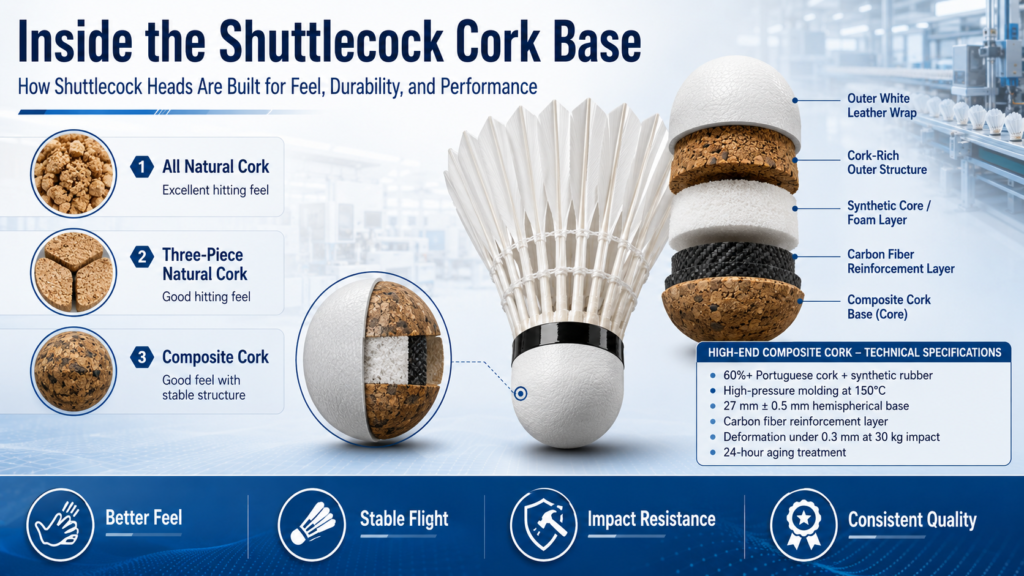
- the drilled cork base
- the inner glue groove
This bond must be strong enough to absorb repeated hitting force without causing feather loosening or base cracking.
Because the feather roots take direct structural stress during play, the quality of the base glue process has a major effect on shuttlecock durability.
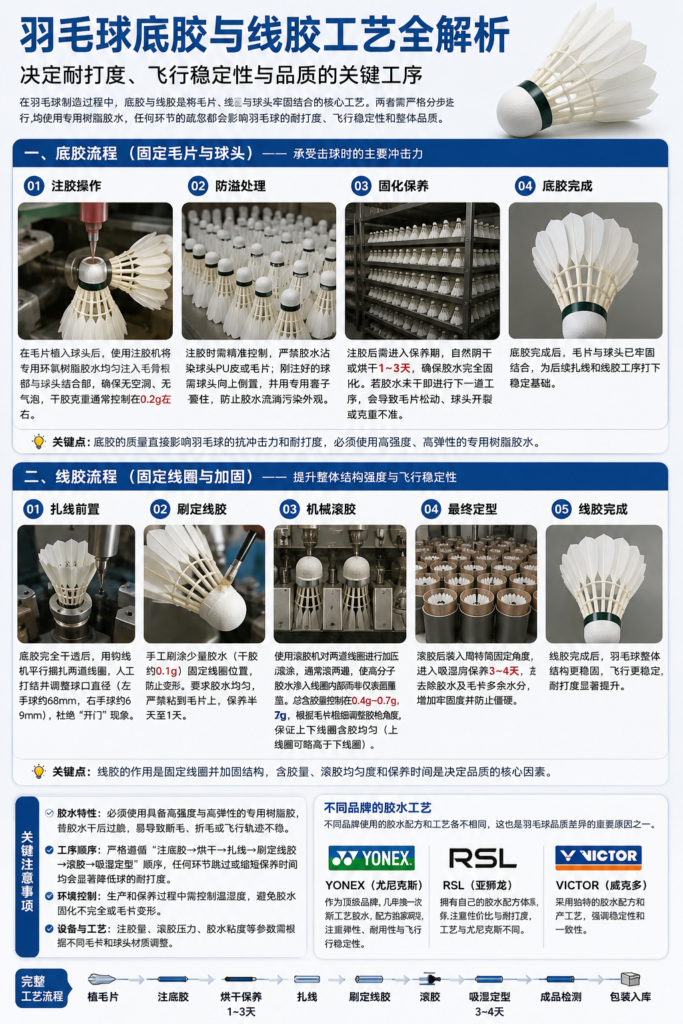
Step 1: Base Glue Injection
After feather insertion, the shuttlecock enters the base glue stage.
Using a glue injection machine or controlled manual system, a specialized epoxy or resin adhesive is evenly injected into the connection area between the feather roots and the shuttlecock head.
At this stage, the main goal is uniform bonding.
A good base glue process requires:
- no empty spaces
- no trapped air bubbles
- even glue distribution
- correct dry glue weight
- no overflow onto the outer PU or leather surface
In many factories, glue amount is carefully controlled because excessive glue can affect shuttlecock weight, balance, and appearance. Too little glue may reduce holding strength.
This is one reason why high-quality shuttlecock production requires stable process control rather than simple handwork alone.
Step 2: Overflow Prevention and Clean Handling
After base glue is applied, the shuttlecock must be handled carefully.
Freshly glued shuttlecocks are usually placed head-up so the adhesive stays in the correct internal bonding zone. In some factories, protective sleeves or holders are used to prevent glue flow and keep the outer surface clean.
This detail may seem small, but it matters.
If glue contaminates:
- the cork head surface
- the PU/leather wrap
- the feather vanes
it can damage the appearance and sometimes affect performance.
A clean base glue process improves both product quality and final presentation, especially for private label shuttlecock brands where visual consistency matters.
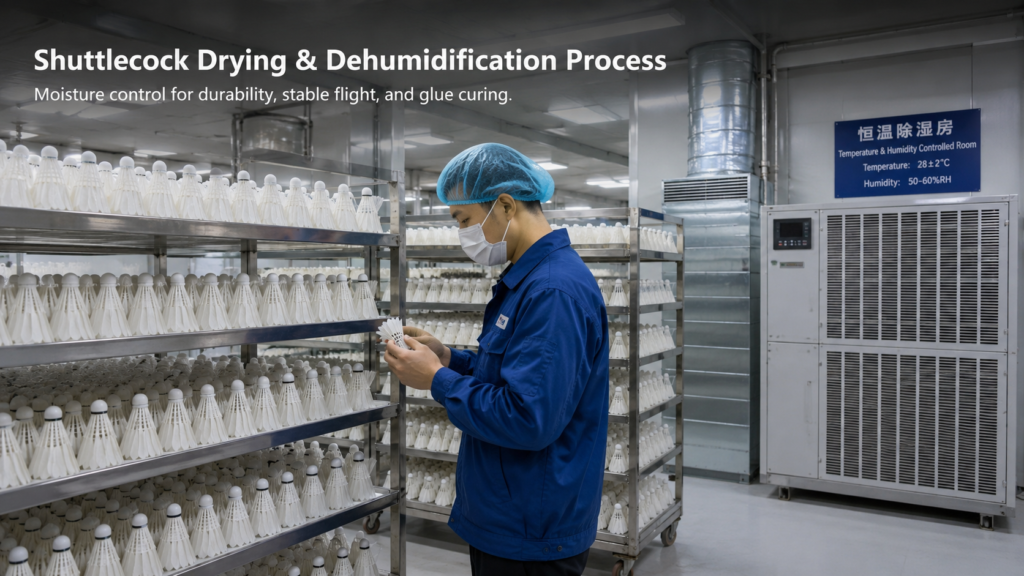
Step 3: Base Glue Curing and Drying
One of the most overlooked steps in shuttlecock manufacturing is curing time.
After base glue is injected, the shuttlecock cannot move directly to the next process. The adhesive needs time to cure properly.
Depending on the factory system and environmental conditions, the glued shuttlecocks may be:
- naturally air-dried
- dried in controlled warming conditions
- stored for 1 to 3 days before the next stage
This curing stage is critical.
If the glue is not fully cured before thread binding or later processing, the shuttlecock may develop problems such as:
- loose feathers
- cracked cork head
- inaccurate weight
- structural weakness
- unstable durability
In professional shuttlecock production, glue curing is part of quality control — not just waiting time.
Part 2: What Is Thread Glue in a Shuttlecock?
After the base glue is fully cured, the shuttlecock moves into the thread binding and thread glue process.
Thread glue does not replace base glue. It is a second structural reinforcement stage.
While base glue fixes the feather roots into the cork base, thread glue helps lock the thread rings and strengthen the entire feather cone structure.
This process is especially important for:
- cone stability
- feather alignment
- impact resistance
- long-term durability
- flight consistency
In other words, base glue creates the foundation, and thread glue reinforces the structure.
Step 4: Thread Binding Before Thread Glue
Before thread glue is applied, the shuttlecock is tied with thread.
This usually involves two parallel thread rings around the feather stems. The purpose is to hold the feathers in the correct cone structure before glue reinforcement.
At this stage, workers or machines adjust the shuttlecock mouth diameter carefully to avoid deformation or “opening” problems.
The thread binding itself already contributes to stability, but without glue reinforcement, the structure may not remain stable after repeated use.
That is why thread glue is required.
Step 5: Fixing Glue for the Thread Position
The first glue step for the thread area is often a small controlled application sometimes referred to as fixing glue.
Its purpose is to:
- secure the thread position
- prevent movement before full reinforcement
- maintain cone shape
- reduce deformation risk
This glue must be applied carefully and evenly.
Just like with base glue, it should not touch the feather vanes. If glue reaches the feather surfaces, it may affect flexibility, appearance, and flight performance.
After this initial thread glue application, the shuttlecock usually enters another short curing period before the next stage.
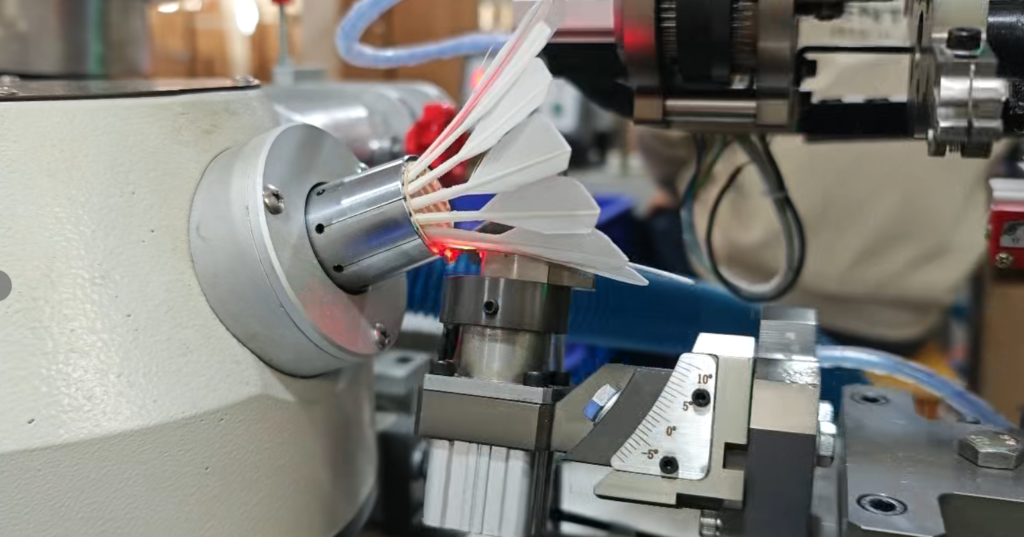
Step 6: Rolling Glue for Full Reinforcement
After fixing glue, the shuttlecock enters the more important thread glue reinforcement stage, often known as rolling glue.
At this stage, a rolling glue machine applies pressure while distributing adhesive onto the two thread rings. The purpose is not simply to coat the surface, but to help the glue penetrate into the thread structure.
This improves:
- bonding strength
- structural stability
- cone retention
- resistance to repeated impact
In many professional shuttlecock factories, the rolling glue process may be repeated more than once to ensure even penetration and stable reinforcement.
Glue amount and machine angle need to be adjusted depending on:
- feather shaft thickness
- thread density
- product grade
- desired durability
This is a technical process, not just a cosmetic one.
A poorly executed thread glue process may leave the shuttlecock looking acceptable, but the structure may loosen quickly during actual play.
Step 7: Final Conditioning and Moisture Stabilization
After rolling glue, the shuttlecock is not immediately packed.
Instead, it is usually placed into holding tubes or fixing containers to maintain its angle and shape. Then it enters a conditioning or humidity-control stage.
This part of the process helps:
- remove extra moisture
- stabilize the glue structure
- maintain cone angle
- reduce brittleness
- improve final durability
In many factories, this conditioning stage lasts several days.
This is one of the reasons why good feather shuttlecocks cannot be rushed. Shortening curing or conditioning time may reduce production time, but it usually harms durability and consistency.
Why Shuttlecock Glue Must Be Flexible, Not Just Strong
One common misunderstanding is that stronger glue is always better.
In fact, shuttlecock glue must offer both high strength and high elasticity.
If the adhesive becomes too brittle after curing, it may create several problems:
- feather stems may break more easily
- the thread area may harden excessively
- the shuttlecock may lose resilience
- flight may feel stiff or less natural
This is why specialized resin systems are used in shuttlecock production instead of common adhesives.
A good shuttlecock glue should:
- bond firmly
- remain slightly flexible
- absorb repeated impact
- resist cracking
- work well with natural feather materials
This balance is one of the hidden technologies behind high-quality shuttlecock manufacturing.
Why Different Brands Use Different Glue Systems
In the badminton market, glue technology is not completely standardized.
Different brands often use their own adhesive processes, curing methods, glue content control, and structural preferences.
Top brands usually continue improving adhesive systems over time because glue performance affects:
- durability
- player feel
- flight stability
- consistency between batches
Some premium brands invest heavily in proprietary glue formulations and production processes, which is one reason their shuttlecocks often feel different from lower-end products even when feather grades look similar.
For OEM shuttlecock buyers, this is an important lesson:
A shuttlecock is not defined only by its feathers.
The glue system and assembly process also shape the final quality.
How Base Glue and Thread Glue Affect OEM Shuttlecock Orders
For distributors, clubs, and private label badminton brands, glue quality directly influences customer feedback.
If the base glue is weak, customers may complain about:
- loose feathers
- head cracking
- poor durability
If the thread glue is poorly controlled, customers may notice:
- cone deformation
- reduced flight consistency
- short product life
- unstable feather arrangement
This is why serious OEM buyers should not only ask about feather grade, cork type, or price.
They should also ask:
- What glue type is used?
- How is base glue controlled?
- How long is the curing time?
- How is thread glue applied?
- Is there a conditioning stage after glue application?
A reliable OEM shuttlecock factory should be able to explain these details clearly.
What Buyers Should Look for in a Professional Shuttlecock Factory
If you are sourcing feather shuttlecocks in bulk, a professional factory should control the full sequence:
- feather insertion
- base glue injection
- curing and drying
- thread binding
- fixing glue
- rolling glue
- final conditioning
- inspection and packaging
This full sequence matters because skipping or shortening any of these stages can reduce product quality significantly.
A reliable shuttlecock manufacturer should also be able to match glue process to product level:
- training shuttlecocks
- club shuttlecocks
- cầu lông giải đấu
- private label custom shuttlecocks
Different shuttlecock grades may require different process balance between cost, durability, and feel.
Final Thoughts
In the shuttlecock manufacturing process, base glue and thread glue are two of the most important hidden technologies.
Base glue secures the feather roots to the cork head and provides the first level of structural strength. Thread glue reinforces the thread rings, stabilizes the cone structure, and improves durability and flight consistency.
Together, these processes help determine whether a shuttlecock is:
- durable
- stable in flight
- consistent from piece to piece
- suitable for club or tournament use
For OEM shuttlecock buyers, understanding these details helps explain why some shuttlecocks last longer, fly better, and feel more reliable than others.
If you are looking for an OEM shuttlecock manufacturer, do not focus only on feather grade or price. Ask how the base glue and thread glue processes are controlled.
Because in a high-quality feather shuttlecock, what holds everything together is just as important as what you can see.