


Berita
Why Are Shuttlecock Prices Falling While Feather Costs Remain High?
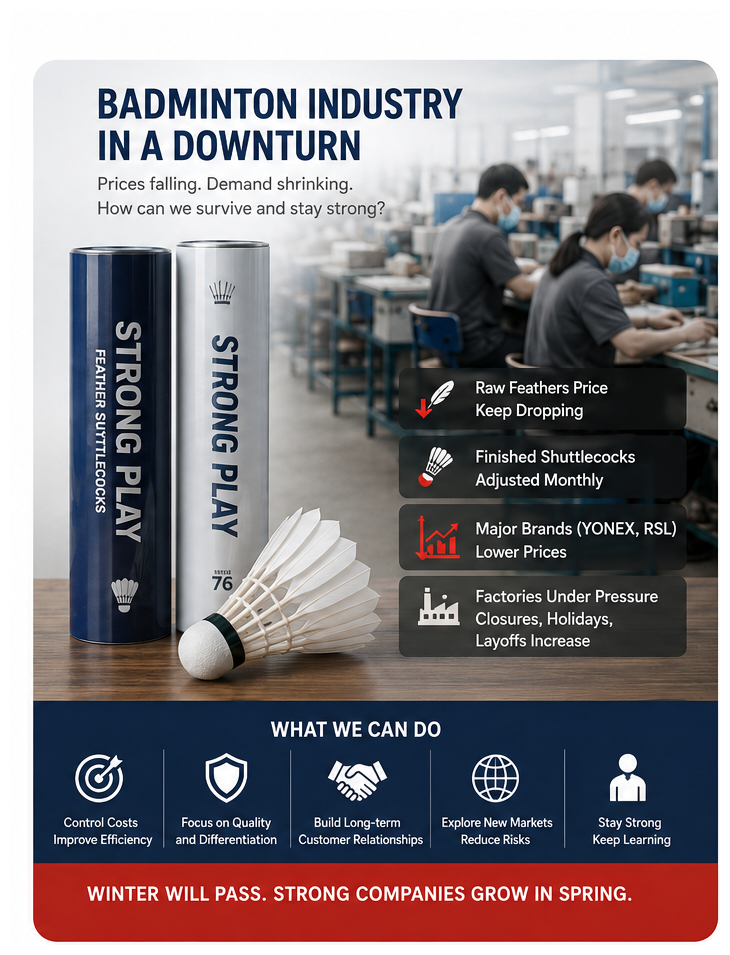
The 2026 shuttlecock market looks contradictory.
In parts of the feather supply chain, shuttlecock-grade feather quotations remain firm and can still move upward.
At the same time, major badminton brands have already reduced finished shuttlecock prices, distributors are buying more cautiously, and many factories are finding it harder to secure orders.
How can raw materials stay expensive while finished products become cheaper?
The answer is not really a contradiction.
It is an inventory cycle.
Daftar isi
AlihkanThe Market Is Still Digesting the Previous Price Boom
During 2024 and 2025, feather shuttlecock prices rose rapidly.
Raw feather costs increased, finished shuttlecock prices followed, and many distributors, retailers and badminton clubs became worried that prices would continue rising.
The natural reaction was to buy more.
Some businesses increased inventory simply to avoid paying even higher prices later.
That worked while the market was still rising.
But once prices stopped climbing, the same inventory became a problem.
In early 2026, several major shuttlecock brands reduced prices, with public reports describing widespread price adjustments after the Spring Festival. Inventory pressure and competition were both cited as important reasons.
Now many distributors are asking a different question:
Why buy another large shipment today if I am still selling inventory purchased months ago?
This Is Why Factory Orders Can Suddenly Slow Down
End-user badminton demand does not need to collapse for factory orders to fall sharply.
Imagine a distributor normally sells 1,000 tubes per month.
During a rising market, the distributor may order 2,000 or 3,000 tubes because they expect another price increase.
That extra purchasing creates temporary demand for the factory.
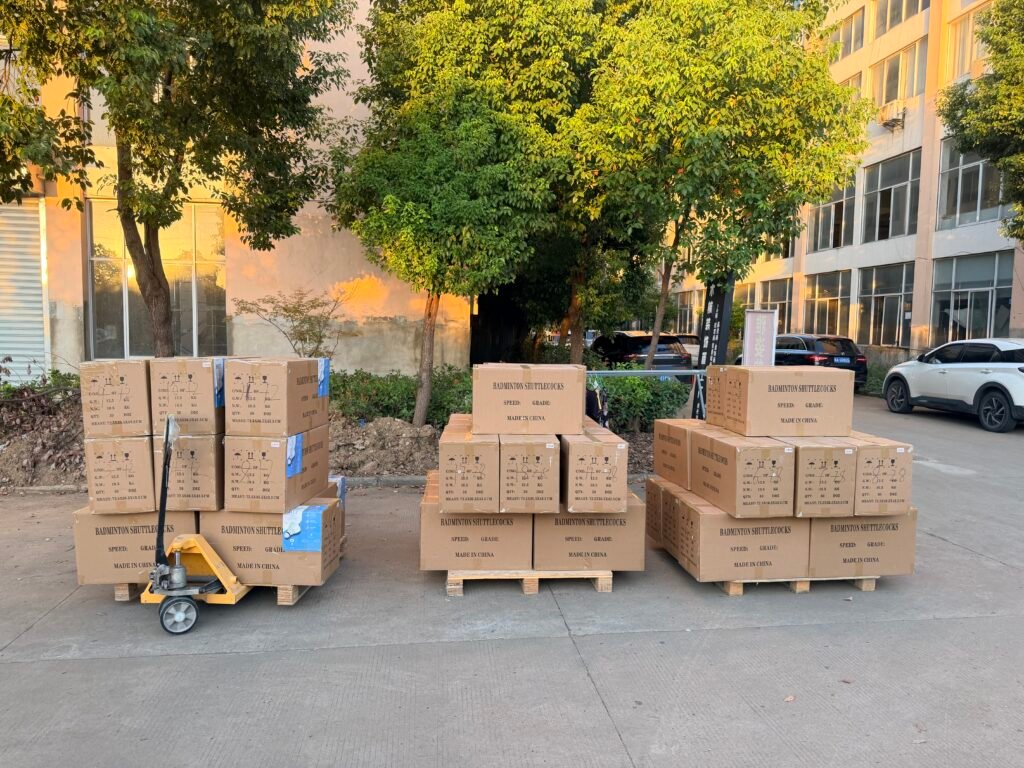
Later, when prices turn downward, the distributor may still sell 1,000 tubes per month to players but order only 300 or 500 tubes from the factory because the warehouse is already full.
From the factory’s perspective, demand appears to have fallen dramatically.
From the consumer’s perspective, people may still be playing badminton.
The difference is inventory.
This is why upstream factories often feel a downturn earlier and more severely than badminton halls or retail stores.
Finished Shuttlecock Prices Do Not Follow Raw Materials Immediately
There is also a time lag.
A shuttlecock sold today may have been produced from feathers purchased months earlier.
Factories may still be carrying expensive feather inventory even after the spot market changes.
The opposite also happens.
A brand may reduce its selling price because of market competition even while the factory’s current raw-material cost remains high.
That squeezes the middle of the supply chain.
In March 2026, Chinese market reports noted that feather prices had already declined from their 2025 peak, but the effect took months to reach finished shuttlecock prices because manufacturers first had to consume expensive inventory.
The same lag can work in reverse.
That is why:
today’s feather price is not necessarily today’s factory cost.
And today’s retail price does not necessarily tell you whether the manufacturer is making a healthy margin.
The Upstream Market Is Still Volatile
Another reason factories should be cautious is that feather markets have not settled into a simple downward trend.
Broader Chinese feather and down market data showed renewed upstream strength in August and early September as raw-material supply tightened, followed by a modest price correction in mid-September as trading weakened.
Shuttlecock-grade wing feathers are a more specialized market than ordinary down, so the two should not be treated as identical.
But the broader signal is useful:
raw-material markets are still unstable.
For manufacturers, this is a dangerous environment in which to make large speculative purchases.
Why Cutting Prices Does Not Immediately Restore Orders
Lower prices can help badminton consumption recover.
But price cuts do not instantly clear distributor inventory.
A wholesaler who already has six months of stock does not suddenly need another container simply because the factory lowers its price by 5%.
First, existing inventory has to move.
Then distributors regain confidence.
Only after that do factory orders begin to normalize.
This is why the current adjustment may take time.
The market has to work through three stages:
High-cost inventory → inventory reduction → normal replenishment
Factories that mistake the second stage for permanent market collapse may panic unnecessarily.
Factories that assume the boom will return immediately may make an even bigger mistake.
What Shuttlecock Manufacturers Should Do Now
This is not the right time for blind expansion.
Increasing production capacity simply because badminton remains popular can create more inventory at exactly the wrong point in the cycle.
The priority should be:
cash flow, inventory control and production flexibility.
That means buying feathers more carefully, shortening purchasing cycles where possible, controlling finished-goods inventory and avoiding unnecessary production simply to keep machines busy.
Quality should not be sacrificed to chase lower prices.
A factory can survive a temporary reduction in volume.
It is much harder to recover after destroying its reputation with unstable quality.
Alternative Shuttlecocks Are Worth Developing — But Not Blindly
Synthetic and nylon shuttlecocks can also become part of risk management.
They reduce dependence on natural feathers and can serve schools, beginners, recreational players and high-volume training environments.
But manufacturers should not assume synthetic products will automatically replace feather shuttlecocks.
Price, durability, flight and player acceptance still matter.
If a synthetic shuttlecock costs nearly the same as a natural feather product while players prefer the natural feel, the commercial argument remains weak.
So diversification makes sense.
Betting everything on synthetic shuttlecocks does not.
Cash Flow Matters More Than Market Share Right Now
During a rising market, inventory can look like an asset.
During a falling or uncertain market, inventory can quickly become trapped cash.
That changes the priority.
For manufacturers, traders and distributors, the most important question in this stage is not:
How much more can we sell?
It is:
How much working capital are we willing to lock into inventory before demand becomes clearer?
Sometimes protecting cash is more important than winning another few percentage points of market share.
Final Thoughts
The current shuttlecock market is not as contradictory as it first appears.
Raw-material prices can remain firm.
Finished shuttlecock prices can fall.
Factory orders can weaken.
Badminton participation can still remain strong.
All four things can happen at the same time because different parts of the supply chain are operating on different inventory cycles.
The market will eventually rebalance.
High-cost inventory will be consumed.
Raw-material prices will find a new level.
Distributors will start replenishing stock again.
Factory orders will recover when inventories return to healthier levels.
Until then, the sensible strategy is not aggressive expansion.
Control inventory. Protect cash flow. Keep quality stable. Stay flexible.
In a market going through an inventory correction, survival is often less about predicting the exact bottom and more about making sure you are still financially healthy when the next replenishment cycle begins.