Custom shuttlecock packaging often looks like the easiest part of an OEM order.
The feathers have already been selected. The shuttlecocks have been assembled, glued, dried, speed-tested, and inspected. The tubes are printed. Labels are ready. At that point, it feels like the difficult work is already finished.
Then packaging begins.
That is exactly where one of our recent orders reminded us that a small label can still create a full day of extra work.
## Two Shuttlecock Models, Two Packaging Designs
The order included two shuttlecock models.
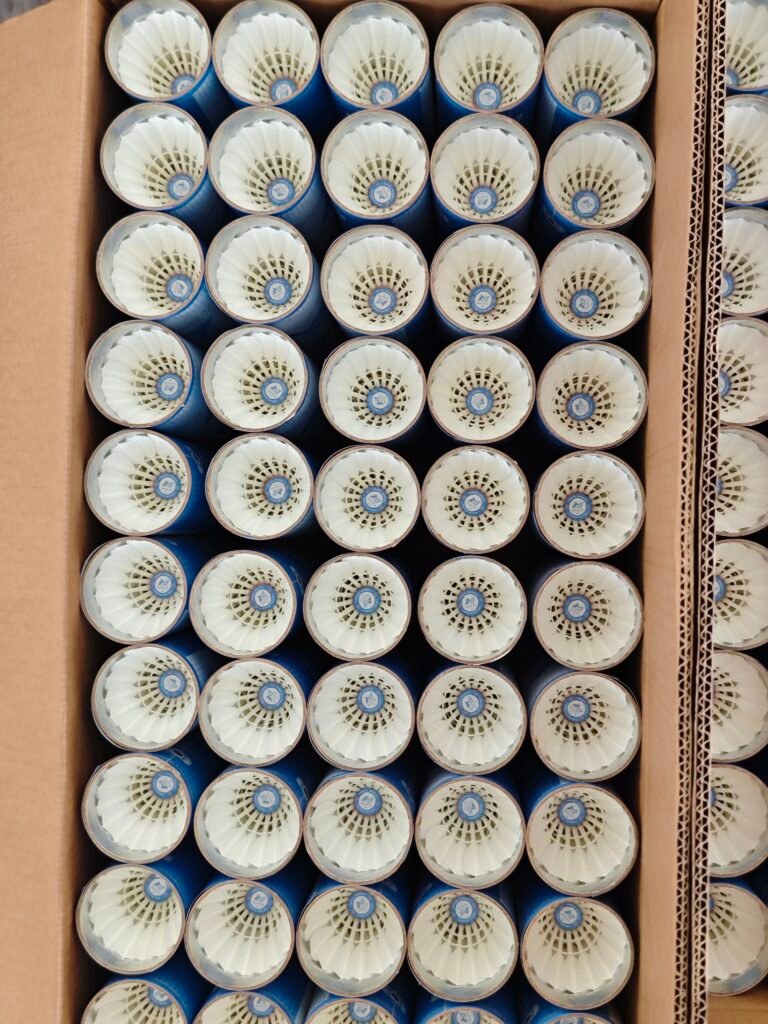
Each model had its own main tube label and should also have had its own matching round centre label.
The original packaging arrangement was simple:
* Model A → Main Label A + Centre Label A
* Model B → Main Label B + Centre Label B
However, during the early confirmation stage, the customer initially approved only one centre-label design.
That was manageable. We prepared the order according to the confirmed artwork and continued production.
Then, shortly before final packing, the customer decided to add a second centre label for the other model.
This was not a major problem by itself. Custom packaging changes happen frequently in OEM shuttlecock orders.
The difficulty came from timing.
The new label arrived when the goods were already very close to the packing stage.
## Then We Packed Model A as Model B
During final packaging, the two products were being packed at the same time.
The tube designs were similar, and both centre labels were now in use.
At some point, part of Model A was packed with the Model B label.
The shuttlecocks inside were correct.
The product quality was correct.
The speed was correct.
The only problem was the label.
But for a private label product, that is still a real problem.
A customer cannot receive a Model A shuttlecock inside packaging that identifies it as Model B.
Once we discovered the mistake, there was only one correct solution:
Stop packing.
Remove the wrong labels.
Check the affected tubes one by one.
Apply the correct labels again.
Then inspect the entire packing batch before continuing.
## One Small Label Cost Almost One Working Day
Removing a label sounds easy until you need to do it repeatedly without damaging the tube.
Workers had to peel off the incorrect labels carefully, clean the surface where necessary, identify the correct model again, apply the replacement labels, and recheck every tube.
The mistake cost us almost a full working day of labour.
Fortunately, we had enough production and shipping buffer, so the customer’s delivery schedule was not affected.
The shipment still left on time.
But internally, it was a useful reminder:
**Packaging is part of production, not an afterthought.**
## Why Custom Shuttlecock Packaging Becomes Complicated
Private label shuttlecock packaging can involve much more than one printed tube.
Depending on the customer, an order may include:
* different tube artwork;
* model-specific labels;
* shuttlecock speed stickers;
* round centre labels;
* holographic or anti-counterfeit stickers;
* embossed caps;
* inner tube printing;
* different carton markings;
* different barcodes for different markets.
Once a buyer has several shuttlecock grades, several speeds, and several packaging versions, the number of possible combinations increases quickly.
For example, imagine a brand selling:
* 2 shuttlecock models;
* 3 speeds;
* 2 packaging versions.
That already creates multiple packing combinations from products that may look very similar on the factory floor.
This is why OEM shuttlecock packaging needs its own quality control system.
## Late Packaging Changes Carry More Risk Than Buyers Realise
We understand why customers sometimes make changes close to shipment.
Maybe the distributor has changed its product positioning.
Maybe the original label does not look right after printing.
Maybe the buyer suddenly decides that each model needs a separate colour or product code.
These requests are normal in custom shuttlecock production.
However, a design change made during product development is very different from the same change made during final packing.
Late changes can affect:
* label purchasing;
* printing schedules;
* packing instructions;
* worker training;
* SKU separation;
* final inspection;
* shipment timing.
The physical cost of a label may be small.
The operational cost of changing it at the last moment may be much larger.
## The Real Problem Was Not the Label
When we reviewed the mistake afterwards, the problem was not simply that someone applied the wrong sticker.
The deeper problem was that the packaging specification changed too close to final assembly, while two similar products were being handled together.
This created an unnecessary opportunity for confusion.
That is an important distinction.
Good quality control is not only about finding mistakes.
It is about designing the process so that mistakes are difficult to make in the first place.
## What We Changed After This Order
A real production mistake is only valuable if the factory learns from it.
For future custom shuttlecock orders with multiple models, we now pay more attention to several points.
### Final Packaging Artwork Must Be Frozen Earlier
Whenever possible, all labels, colours, model names, barcodes, and speed markings should be confirmed before bulk packaging begins.
Once packing starts, design changes should be treated as production changes rather than simple artwork changes.
### Each Model Needs a Clear Packaging Reference
Before packing, workers should have a physical reference showing the complete approved combination:
**Shuttlecock Model + Tube + Centre Label + Speed Sticker + Carton Mark**
This is much safer than asking workers to remember which label belongs to which model.
### Similar Models Should Be Packed Separately
If Model A and Model B use similar tubes, we prefer not to have both packaging materials mixed at the same workstation.
Finish one model first whenever the production schedule allows.
Then clear the packing area before moving to the next.
This simple separation greatly reduces the risk of label mixing.
### The First Packed Tubes Need Approval
Before hundreds of tubes are packed, the first few finished units should be checked against the customer-approved artwork.
A five-minute inspection at the beginning can prevent several hours of rework later.
### Final Carton Inspection Still Matters
Even after the individual tubes are correct, cartons should be checked again by model, speed, quantity, and shipping mark.
A packaging mistake discovered inside the factory costs labour.
The same mistake discovered after arrival in another country costs much more.
## Why Packaging Accuracy Matters for Private Label Shuttlecock Brands
To a factory, a wrong label may initially look like a small production error.
To the customer, it affects the identity of the product.
Private label badminton brands depend on consistent presentation. Their customers need to know exactly which model they are buying.
If two grades are mixed visually, it can create:
* incorrect retail sales;
* customer complaints;
* warehouse confusion;
* distributor problems;
* damaged brand credibility.
This is why OEM packaging quality control needs the same seriousness as shuttlecock flight testing.
We test whether a shuttlecock flies correctly.
We also need to check whether it leaves the factory wearing the correct name.
## A Good Factory Is Not a Factory That Never Makes a Mistake
Manufacturing involves people, machines, natural materials, changing customer requests, and deadlines.
Mistakes can happen.
The more useful question is what happens after the mistake is discovered.
In this order, we could have ignored the label difference because the shuttlecocks themselves were correct.
We did not.
We stopped the packing process, removed the incorrect labels, repacked the products, checked the affected stock, and still completed the shipment within the agreed schedule.
It cost us time and labour.
But sending incorrectly labelled products would have cost the customer more.
That was not a difficult decision.
## What OEM Buyers Can Do to Reduce Packaging Problems
Customers can also make custom packaging production much smoother by confirming several details before mass production:
* final model names;
* tube artwork;
* centre labels;
* cap design;
* speed stickers;
* barcode information;
* carton marks;
* quantities for each SKU.
It is also helpful to avoid repeatedly changing artwork once packaging materials have entered production.
Customisation is one of the biggest advantages of working with an OEM shuttlecock manufacturer.
But successful customisation requires both flexibility and discipline.
The more customised the packaging becomes, the more important final confirmation becomes.
## Final Thoughts
This order ended well.
We lost almost one day correcting a packaging mistake, but the shipment was still completed on schedule and the customer received the correct products.
For us, the experience was another reminder that the final step of shuttlecock manufacturing deserves just as much attention as the earlier ones.
Good feathers matter.
Good cork matters.
Speed testing matters.
Flight stability matters.
And when everything else is finished, **the correct label on the correct tube still matters.**
Custom shuttlecock packaging is not difficult because stickers are complicated.
It is difficult because every small detail represents the customer’s brand.
And once a product carries someone else’s brand, “almost correct” is not good enough.
Written by Ethan Tang | Delo Shuttlecock & Feather Supply Team
Updated: 25th August 2026