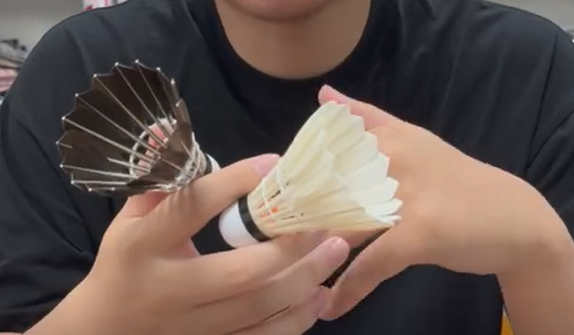
For the past few years, synthetic shuttlecocks had one of the strongest arguments they had ever been given.
Natural feather shuttlecocks were becoming expensive.
Goose and duck feather supply tightened, raw material costs climbed, major badminton brands raised prices repeatedly, and clubs around the world began asking the same question:
Is there finally a practical alternative to natural feather shuttlecocks?
Synthetic shuttlecocks suddenly looked much more attractive.
They promised more stable raw material supply, longer durability, lower dependence on poultry feathers, and potentially lower playing costs.
In April 2026, the Badminton World Federation approved synthetic shuttlecocks from VICTOR and YONEX for use at selected Grade 3 and Junior International tournaments. That was an important step for the category.
But something else is happening at the same time.
Natural feather prices are falling again.
And that changes the conversation completely.
The question is no longer:
Can synthetic shuttlecocks replace expensive feather shuttlecocks?
The harder question is:
If a good synthetic shuttlecock costs almost the same as a natural feather shuttlecock, why should players switch?
The Feather Shortage Created the Perfect Opportunity for Synthetic Shuttlecocks
The rise of synthetic shuttlecocks did not happen in isolation.
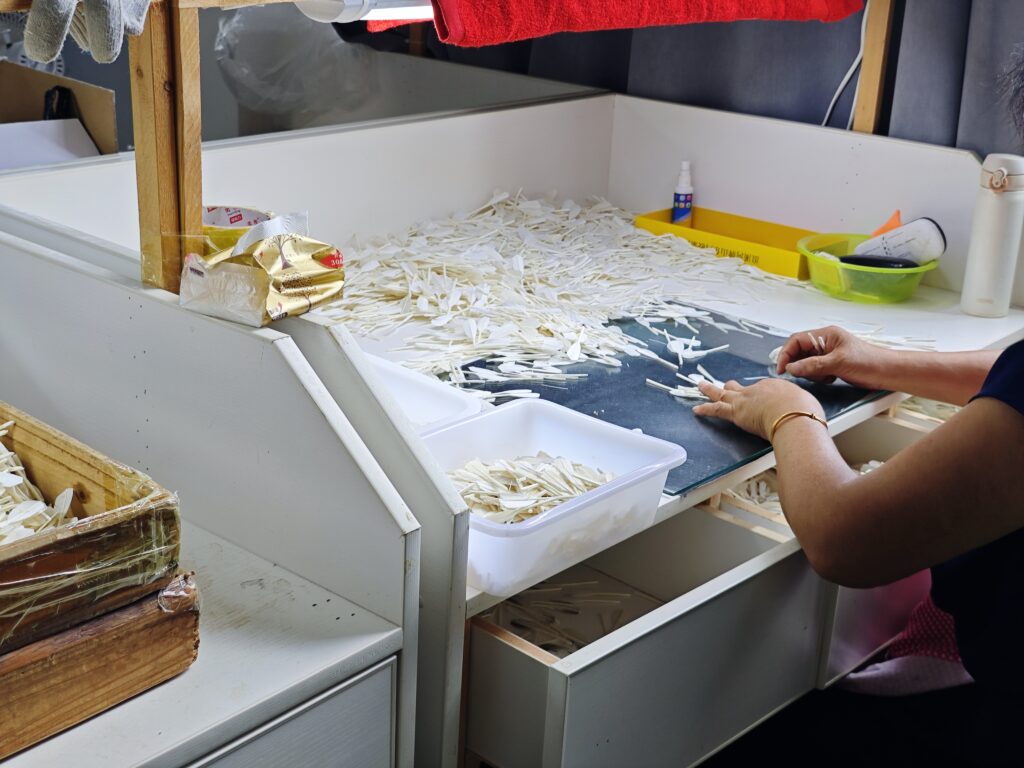
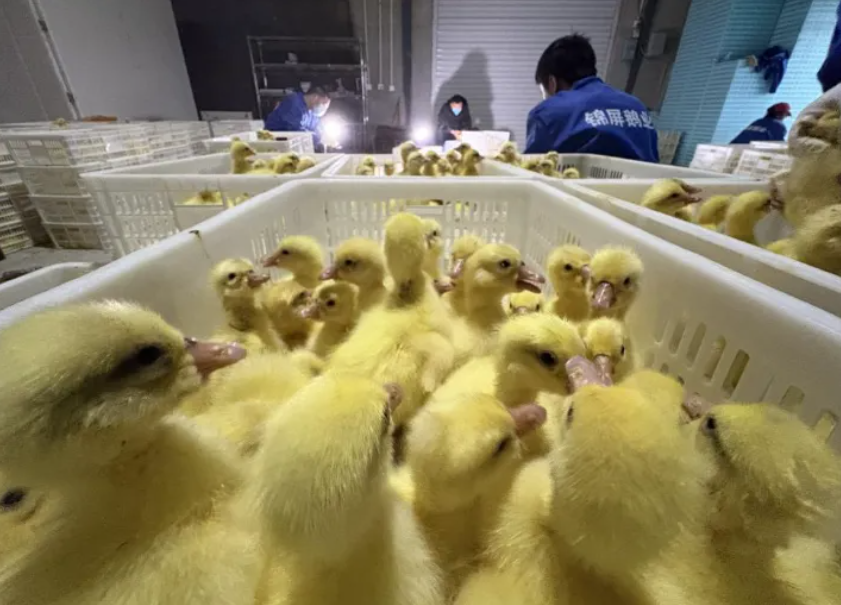
From 2022 to 2025, natural feather shuttlecock prices increased sharply. High-quality wing feathers became expensive, factories faced raw material shortages, and retail prices repeatedly moved higher.
For clubs using several tubes every week, the problem was no longer small.
Shuttlecocks became one of the largest recurring costs of playing badminton.
That environment gave synthetic products a very clear selling proposition:
Natural feathers are expensive and unstable. Synthetic materials can provide a more predictable alternative.
From a product-development perspective, this made complete sense.
If feather prices continued rising indefinitely, even a synthetic shuttlecock with slightly different flight or feel could become attractive simply because of cost.
But markets do not move in one direction forever.
2026 Has Changed the Economics
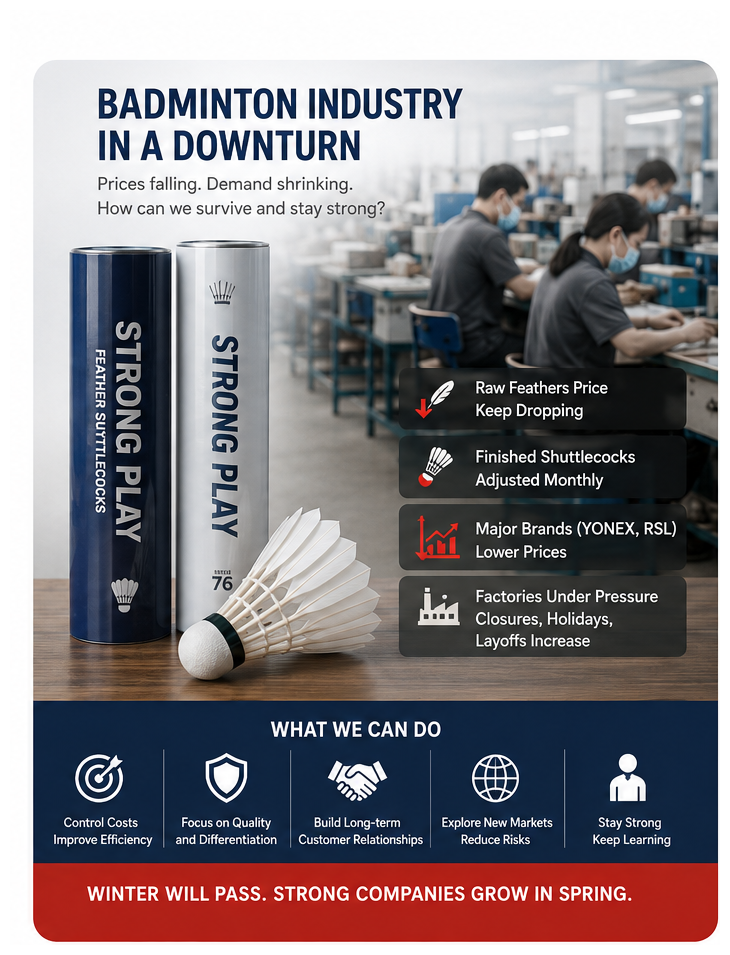
Since late 2025, shuttlecock feather prices in China have been moving downward.
By 2026, finished shuttlecock prices also began correcting. Several major Chinese-market brands reduced prices, and distributors became much more cautious about carrying expensive stock.
For natural feather shuttlecock manufacturers, this correction is painful.
For synthetic shuttlecock manufacturers, however, it creates a different problem.
Their strongest competitor is becoming cheaper again.
When a natural feather shuttlecock was extremely expensive, buyers might tolerate a compromise in hitting feel because the potential cost saving was large.
When the price gap becomes small, that compromise becomes harder to justify.
This is the part of the synthetic shuttlecock discussion that deserves more attention.
Price Parity Is a Serious Problem for Synthetic Shuttlecocks
From what we currently see in the Chinese badminton market, synthetic shuttlecocks have not yet become a mainstream replacement for natural feather products.
One reason is simple: price.
Better synthetic shuttlecocks are not necessarily cheap.
Some premium synthetic products are already priced close to decent natural feather shuttlecocks.
At the lower end, inexpensive synthetic shuttlecocks also compete with inexpensive duck feather shuttlecocks at similar price points.
That creates a very difficult question for the consumer.
If I can buy a natural feather shuttlecock at the same price, and I already prefer the flight, sound and hitting feel of natural feathers, what exactly is my reason to change?
Technology alone is not enough.
A new product needs a clear economic or performance advantage.
Synthetic Shuttlecocks Need to Win on More Than One Factor
For synthetic shuttlecocks to build a large permanent market, they cannot rely only on the argument that natural feathers are difficult to source.
They need to deliver a convincing combination of advantages.
| Factor |
Natural Feather Shuttlecock |
Synthetic Shuttlecock |
| Traditional hitting feel |
Strong advantage |
Improving |
| Familiar flight trajectory |
Strong advantage |
Improving |
| Player acceptance |
Very high |
Still developing |
| Raw material stability |
Vulnerable to feather supply |
Strong advantage |
| Durability potential |
Depends heavily on feather grade |
Potential advantage |
| Price advantage |
Improving as feathers fall |
Not always obvious |
| High-level player familiarity |
Strong advantage |
Limited |
| Supply scalability |
Constrained by natural feathers |
Strong advantage |
This is why we do not believe the future should be discussed simply as “synthetic versus feather.”
The real question is whether the synthetic product gives the customer enough additional value to justify changing habits.
Durability Alone Does Not Automatically Mean Better Value
Synthetic shuttlecock marketing frequently focuses on durability.
That makes sense.
If one synthetic shuttlecock can survive significantly longer than one natural shuttlecock, then its purchase price can be higher and it may still cost less to use.
But buyers should measure this properly.
The relevant number is not:
price per tube.
It is:
cost per playing hour.
Imagine two products.
A natural feather shuttlecock costs $18 per tube and a club uses six shuttlecocks during a session.
A synthetic shuttlecock costs $18 per tube but the club only uses two during the same session.
The synthetic shuttlecock has a powerful economic argument.
Now consider another case.
A natural shuttlecock costs $14 and provides the preferred playing experience.
A synthetic shuttlecock costs $15 but lasts only slightly longer.
In that situation, the purchasing argument becomes much weaker.
This is why durability claims should be tested on court rather than accepted from a brochure.
Players Do Not Buy Shuttlecocks by Material Alone
People sometimes discuss shuttlecocks as if they are simply consumable objects.
Experienced badminton players know otherwise.
They notice:
- initial acceleration;
- deceleration after a smash;
- rotation;
- flight arc;
- impact sound;
- cork response;
- net feel;
- consistency after several rallies.
Natural feather shuttlecocks have shaped competitive badminton for generations.
Players have developed their timing around those characteristics.
That creates a major barrier for synthetic products.
A synthetic shuttlecock does not need to be technologically impressive.
It needs to feel sufficiently normal that players stop thinking about the fact that it is synthetic.
That is a much harder engineering problem.
BWF Approval Matters — But It Does Not Equal Mass Adoption
BWF’s 2026 decision to allow synthetic shuttlecocks from YONEX and VICTOR at selected Grade 3 and Junior International tournaments is significant.
It gives manufacturers an opportunity to collect data and feedback in genuine competitive environments rather than only laboratory or training conditions.
It also gives synthetic shuttlecocks something they have needed for years: legitimacy beyond recreational badminton.
But trial use and widespread acceptance are not the same thing.
The badminton market will still judge these products through:
- player feedback;
- tournament experience;
- durability;
- flight consistency;
- price;
- availability;
- long-term repeat purchases.
A product can be approved for use and still struggle commercially.
Real adoption begins when players and clubs voluntarily buy it again.
China May Be an Important Reality Check
China is an interesting market for synthetic shuttlecocks because badminton participation is deep and players have extensive experience with natural feather products.
From our own market observation, synthetic shuttlecock sales in China remain relatively modest compared with natural feather shuttlecocks.
That does not mean synthetic shuttlecocks have failed.
It means the purchasing threshold is high.
Chinese players can access a wide range of natural shuttlecocks across almost every price level.
Premium goose feather products exist.
Mid-range club shuttlecocks exist.
Cheap duck feather training shuttlecocks also exist.
A synthetic product therefore cannot succeed simply by saying:
“We are cheaper than premium feather shuttlecocks.”
It may actually be competing with a natural shuttlecock at exactly the same retail price.
That is a much tougher comparison.
Falling Feather Prices Could Slow Synthetic Adoption
This is the point that many optimistic forecasts miss.
Synthetic shuttlecocks gained momentum partly because natural feather shuttlecocks became unusually expensive.
If natural feather prices continue moving downward, the urgency to switch decreases.
A club that was considering synthetic products because its traditional shuttlecock doubled in price may reconsider if feather shuttlecock prices return to a more comfortable range.
This does not eliminate the synthetic market.
But it changes its value proposition.
Synthetic manufacturers can no longer depend only on:
“Feathers are becoming too expensive.”
They need to prove:
“Our product gives you better value even when feather prices are reasonable.”
That is a much stronger test.
Where Synthetic Shuttlecocks Still Have a Strong Opportunity
We do believe synthetic shuttlecocks have a future.
But that future may be more segmented than some people expect.
Schools and Junior Training
These environments consume large numbers of shuttlecocks and may place greater importance on durability and operating cost than perfect tournament-level feel.
A well-designed synthetic shuttlecock can make economic sense here.
High-Volume Training Centres
If durability is significantly higher, academies and commercial training facilities can reduce shuttlecock consumption.
Again, the important metric is cost per training hour.
Recreational Badminton
Many recreational players do not require exactly the same feel demanded by competitive players.
If synthetic products become more durable and affordable, this market can continue growing.
Markets with Unstable Feather Supply
Synthetic products also provide supply-chain insurance.
Even if natural feathers are cheaper today, future poultry production, disease outbreaks or sudden demand changes can make the market volatile again.
Large badminton brands have good reasons to maintain a second material system.
It reduces dependence on one natural raw material.
Natural Feather Shuttlecocks Still Have a Powerful Advantage
Natural feathers have something synthetic products cannot manufacture overnight:
player habit.
Competitive players already understand how a good feather shuttlecock behaves.
They trust its trajectory.
They understand its sound.
They know how it feels on a clear, smash, drive and net shot.
As long as natural feather shuttlecocks remain available at an acceptable price, replacing that familiarity will be difficult.
This is especially true in serious club and tournament environments.
If a player has two products at a similar price and prefers the feather shuttlecock, sustainability arguments or manufacturing technology may not be enough to change the purchasing decision.
The product still has to win on court.
What OEM Buyers Should Test Before Choosing Synthetic
For distributors and private-label badminton brands, this should not become an ideological decision.
Do not choose synthetic because it is new.
Do not choose natural feather only because it is traditional.
Test both.
A serious comparison should include the same players, the same hall and similar playing conditions.
Measure:
- shuttlecocks consumed per hour;
- flight stability;
- speed consistency;
- durability;
- hitting feel;
- player preference;
- price per tube;
- actual cost per session.
Then ask the most important question:
Will customers buy this product again at this price?
That answer matters more than any marketing claim.
Our View as a Shuttlecock Manufacturer and Trader
We work closely with natural feathers and feather shuttlecock production.
Naturally, we understand the advantages of traditional feather shuttlecocks very well.
But rejecting synthetic products simply because they threaten the traditional supply chain would be shortsighted.
Synthetic shuttlecocks will improve.
Manufacturers will continue experimenting with new skirt materials, shaft structures, cork combinations and manufacturing processes.
Some categories will almost certainly gain market share.
At the same time, we do not believe buyers should assume that synthetic automatically means cheaper, more advanced or better value.
Every product should justify itself.
If a synthetic shuttlecock offers clearly lower playing cost while maintaining acceptable flight and feel, it deserves a market.
If it costs the same as a good natural feather shuttlecock while offering an experience players like less, then buyers are justified in asking:
Why should we switch?
That is not resistance to innovation.
That is normal purchasing logic.
The Real Competition Is Value, Not Material
The future of badminton does not need one winner.
Natural feather shuttlecocks and synthetic shuttlecocks can coexist.
What will change is where each product makes economic sense.
Natural feather shuttlecocks are likely to remain strong wherever players prioritise traditional flight, feel and competitive performance.
Synthetic shuttlecocks may grow fastest where durability, raw material stability and operating cost matter more.
Hybrid products may create another category between the two.
The market will decide.
And the market will not decide according to press releases.
It will decide according to what players actually keep buying.
Final Thoughts
The feather shortage gave synthetic shuttlecocks their biggest opportunity in years.
BWF tournament trials have pushed the category further forward.
But falling feather prices in 2026 are creating a new test.
Synthetic shuttlecocks now need to prove that their value exists even when natural shuttlecocks are affordable again.
For buyers, the correct question is no longer:
“Are synthetic shuttlecocks the future?”
A better question is:
“At this price, for these players, in this market, which shuttlecock gives us the best combination of flight, durability, feel and real playing cost?”
That is how manufacturers should develop products.
That is how distributors should buy them.
And ultimately, that is how players will decide which shuttlecock survives.
Written by Ethan Tang | Delo Shuttlecock & Feather Supply Team
Updated: August 2026